
By Keenan Kealey, Kealey’s Duct and Dryer Cleaning
A homeowner in Amesbury called me last spring with two quotes in front of her. One was a few hundred dollars. Mine was quite a bit more. She asked the fair question, which was what she would actually be getting for the difference.
That is a hard question to answer over the phone, because the words on both quotes look the same. Both said air duct cleaning. Neither said how many openings, how many systems, how far into the ductwork, or how long anybody would be there.
So here is what actually sits behind that number. Not to talk you out of the cheaper quote, because plenty of the time a smaller job is the right job. It is so you can put the two side by side and see whether you are comparing the same work.
Why do two quotes come back so far apart?
Almost always because they cover different amounts of work.
Duct cleaning is not one fixed thing. A quote can mean the register runs only, or the whole system down to the trunk lines. It can mean one heating system or two. It can be ninety minutes or most of a day. All of those are legitimate services. They are just not the same service, and the price follows the scope.
The trouble is that nothing on the quote tells you which one you are looking at. That part you have to ask.
What is actually in the scope?
Four things drive nearly all of the difference.
How many openings are included
This is the biggest one. Every supply register and every return grille is a separate access point that has to be opened, cleaned and put back.
An older Colonial around here might have eight supplies and two returns. A newer build in Exeter or Stratham can run twenty-two supplies and four returns across two floors. That is close to triple the work in the same trade.
Ask what number the quote assumes, and what happens if your house has more. Some companies price per opening past a set count. That is a perfectly reasonable way to do it, as long as you know before they arrive rather than after.
How many systems the house has
One furnace with one set of trunk lines is straightforward. Two systems, or a heat pump upstairs and a furnace down, or a finished basement running its own zone, is closer to two separate jobs. Each has its own air handler, its own blower and its own duct tree.
Ask whether the price covers the house or one system. This is the single most common reason a quote comes in low, and there is nothing underhanded about it. The scope is simply narrower than the one you had in mind.
Whether the trunk lines are in it
The trunks are the main ducts, usually the large rectangular or round runs in the basement or attic that every branch comes off. The branches carry a little dust. The trunks are where the heavy material settles and sits.
A cleaning that works from each register inward for a few feet is a real service and it will pull out real debris. Running the whole tree is a bigger job. Ask directly: does this include the supply and return trunks, or the register runs only?
What else is on the list
Worth confirming item by item, because the answers vary:
The return side, not only the supplies
The blower compartment and the area around the air handler
Registers and grilles themselves, washed rather than just pulled off
Whether a filter is included or you supply it
Whether the dryer vent is part of the visit or a separate line item
None of these are trick questions. Any company doing the work will answer them in about a minute.
How does the crew get the debris out?
Two things have to happen. The material has to come loose from the metal, and it has to leave the house instead of landing in your living room.
Loosening is done with brushes, air whips or similar tools worked down the runs. Removal is done by putting the system under suction so everything travels toward the collection point rather than out the registers.
The comparison worth making is not brand of equipment. It is whether both parts are happening. A powerful vacuum with nothing agitating the duct wall will pull the loose surface dust and leave what is stuck. Agitation with weak collection puts material into the room.
Ask how the debris is broken loose and where it ends up. If the answer is that everything goes into a shop vacuum in the hallway, that tells you something about the scale of the job being quoted, which may still be fine for a small system.

How long is the crew on site?
Time is the honest proxy for scope, and it is the number people forget to ask about.
A whole-home duct cleaning on a typical single-system house here runs two to three hours. Larger homes or more ductwork push toward three or four. A dryer vent on its own is usually under an hour.
If a quote implies a whole house in forty-five minutes, that is not evidence of bad work. It usually means the scope is narrower than you assumed. Ask what is included in that window and you will normally find the answer sitting right there.
What happens to your floors and your furniture?
Containment is the part nobody asks about and everybody notices afterward.
Reasonable questions: what goes down on the floor and the stair treads, does anything get moved and put back, and where does the collected debris go when the crew leaves. Duct cleaning disturbs material that has been settled for years. Some of it will try to end up in the room.
Will you see proof?
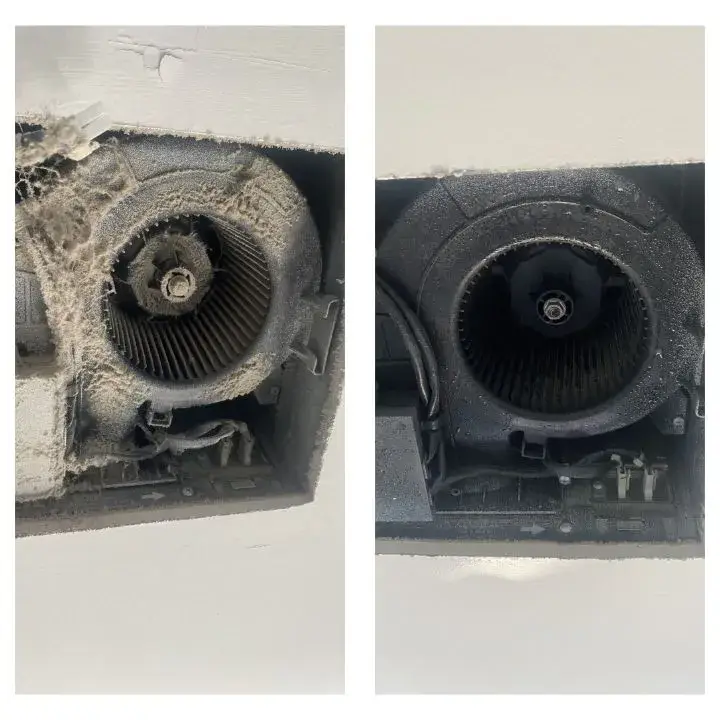
You cannot inspect the inside of your own ductwork, which is the entire problem with buying this service. The only practical fix is photographs of the same spot before and after.
Ask whether you get them, and whether they are of your house rather than a stock example. A company that photographs its own work has no reason to skip the hard-to-reach runs, because the picture would show it.
One thing worth separating out
If somebody finds real mold growth in your system, that is a different trade and a different quote. Duct cleaning removes dust and debris. It is not remediation, and any quote that folds mold work in as a line item deserves a longer conversation about what exactly is being done.
We will show you what we find and tell you plainly when something is outside what we do.
The questions worth asking, in order
Take these to every quote you have, including ours:
How many supply and return openings does this cover, and what happens if there are more?
Is this the whole house or one system?
Does it include the trunk lines or the register runs only?
How is the debris loosened, and where does it go?
How long will you be here?
What gets put down to protect the floors?
Do I get before and after photos of my own ductwork?
What is not included?
Whichever company answers those most clearly is usually the one to book. That is a better test than the number at the bottom.
Verifying Service Quality Through Before-and-After Evidence
We ask most of the list above on the phone, then give you a written price before anyone comes out. If we open things up and find something the call could not see, we stop and you decide before we go further.
Our air duct cleaning page lays out what is in a whole-home job, register to trunk line, and what the visit looks like. If the dryer is the reason you are calling, dryer vent cleaning is the quicker job and plenty of people book both on one visit. Starting rates and the four things that move the number are on our pricing page.
And if the honest answer is that your system does not need anything yet, we will say so. That happens more than you would expect.