
By Keenan Kealey, Kealey’s Duct and Dryer Cleaning
We pulled a dryer away from a wall in Salisbury last winter and found lint sitting on top of the heating element casing like a blanket. The underside of it was charred black. The machine still ran. The homeowner had no idea, and she cleaned her lint screen after every single load.
That is the part most people have backwards. The fire risk is not usually in the pipe behind the wall.
It is inside the dryer, in places you cannot see or reach without taking the machine apart. Brian has been clearing these lines since 1994, and after 32 years the pattern does not change much. So here is how often the job actually needs doing, why living near the water changes the answer, and what a real cleaning covers.
How often should you clean your dryer vent?
Once a year. Never longer than three.
NADCA points homeowners to a yearly schedule and that matches what we find in the field. Annual service keeps the run clear before lint has a chance to pack down into something air cannot move through.
Three years is the ceiling, and we mean it as one. Past that the buildup stops behaving like a coating and starts behaving like a plug. By the time anyone notices a symptom, it has usually been building for a long while.
What the yearly baseline assumes
A once-a-year schedule fits a fairly ordinary household. Five to seven loads a week, a vent run under twenty-five feet without many bends, no pets or pets that barely shed, and a dryer under ten years old.
Move away from any one of those and the interval tightens.
What moves it sooner
| What we look at | Why it matters | Interval |
|---|---|---|
| Loads per week | More cycles push more lint through the same pipe | Yearly for light use, every 6 to 12 months for daily laundry |
| Pets and heavy fabrics | Fur and dander add far more lint than clothing alone | Every 6 to 12 months |
| Run length and bends | Lint catches at every elbow and along long horizontal runs | Yearly, sooner past 25 feet |
| Dryer age | Older machines filter lint less effectively | Yearly once past ten years |
| Coastal exposure | Damp salt air changes how lint behaves and how hardware ages | Yearly, with a look at the outside hood each spring |
Does living on the coast change the answer?
It changes what we find, which comes to the same thing.
Damp salt air makes lint tacky. Instead of traveling along the pipe and out the hood, it grabs the duct wall and stays there. The same run that stays reasonably clear inland will hold onto material here.
Salt is hard on the hardware too. Exterior hoods on seaside homes corrode, and once the hinges seize the flap stops opening. We see a stuck hood on coastal jobs far more often than we see one inland. Some of the worst runs we have opened were second-floor and roof-terminating dryers in older houses near the water, where nobody had looked at the outside end in years.
If you are near the shore in Salisbury, Hampton, Portsmouth or up toward Kittery, stay on the annual schedule and watch that the hood opens freely while the dryer runs. That one look catches most of it.
Where do dryer fires actually start?
The phrase dryer vent cleaning is a little misleading. Vents do not spontaneously catch fire.
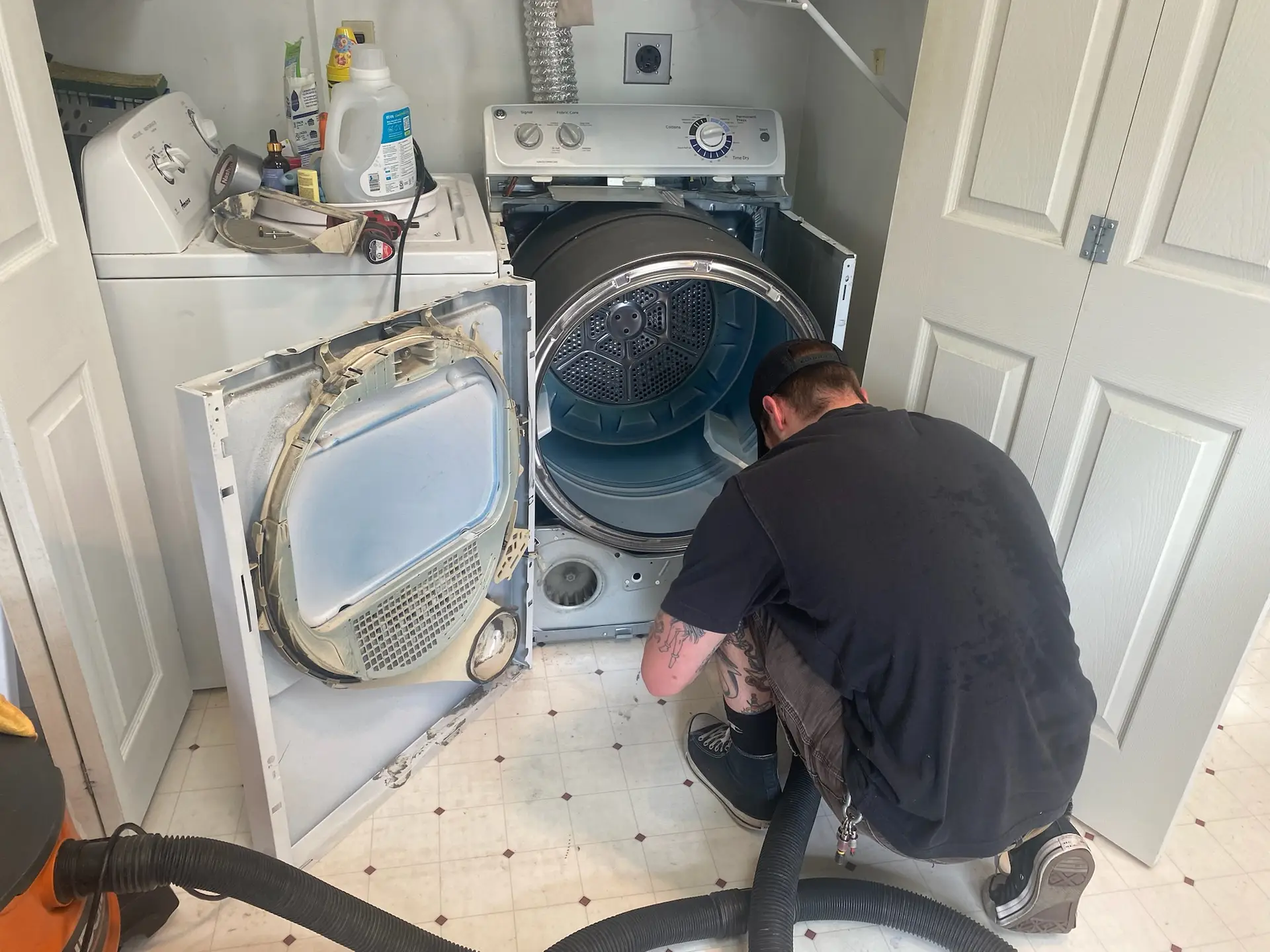
Here is the chain of events instead. When the vent is dirty, air moves through it slowly and back pressure builds. Lint that should be leaving the house has nowhere to go, so it settles inside the machine. It gathers in the lint trap housing, the cavity your screen slides into. It gathers around the heating element, where the machine runs hottest. It coats the blower wheel and fan, which restricts the airflow further. It builds up in the cabinet and in the flexible transition hose behind the dryer.
NFPA data puts failure to clean behind roughly a third of home dryer fires. That is the single largest cause, and it is the one entirely within a homeowner’s control.
Why electric dryers carry the higher risk
Most people assume gas dryers are the dangerous ones because of the flame. NFPA research says otherwise. Electric dryers are more than 2.5 times as likely to cause a fire, and about 78 percent of dryer fires involve electric machines.
The heat discharge is higher, which speeds up the buildup problem. There is a second reason that matters more. Wires spark occasionally in any appliance. In a clean machine there is nothing for that spark to reach. Pack lint around those wires and a small spark has something to hold.
As Keenan puts it: most fires start from a dryer wire sparking, but when there is stuff in there to catch, it goes up quick.
What about carbon monoxide on a gas dryer?
Fire is not the only reason a blocked run matters.
A gas dryer sends combustion gases out through the same pipe as the moist air. Block that path and those gases have to go somewhere, which can mean back into the laundry room. Carbon monoxide has no smell.
Headaches, dizziness or nausea that turn up while the dryer is running deserve attention rather than a wait-and-see. Keep a working CO detector near the laundry area, and stop using a gas dryer if the airflow seems weak until someone has looked at the line. This is the one item on this page where we would tell you to stop and call rather than try anything yourself.
What are the warning signs?
Do not wait for the calendar if you notice any of these. Most of our urgent calls start with one of the first two.
Clothes need more than one cycle. The most common sign and the easiest to measure. If a load that used to finish in one cycle now takes 25 to 50 percent longer, airflow is restricted somewhere. Compare against what your machine used to do, not against a number in a manual.
The dryer or the laundry runs hot. Heat that should be leaving the house is staying in it. If the cabinet or the clothes feel unusually warm after a cycle, and clearing the lint screen does not fix it, stop and have the run checked.
A burning smell while it runs. Treat this as an emergency. Stop the dryer, unplug it, and look at the outside hood for smoke. Do not restart it until someone has opened it up and confirmed the line is clear.
Lint around the door seal or the outside hood. Lint escaping at either end means the pipe is too full to carry it. Piles under the exterior hood usually mean a packed run rather than a tidy one.
The vent flap does not open. Walk outside while a load runs and watch the hood. A flap that stays shut is blocking the exhaust completely. On coastal homes the cause is often a corroded hinge, a nest, or ice in winter.
The dryer shuts off mid cycle. The safety thermostat is doing its job because the machine is overheating. Some newer dryers show a check vent light instead. Either way the machine is telling you something.
What does a complete cleaning include?
A proper job is not a fifteen minute visit. Four things have to happen.
The inside of the dryer comes first, and it is the part most companies skip. We clear the lint trap housing, reach around the heating element, clean the blower wheel and fan, and vacuum the cabinet. On some homes we work through the back pipe, which gives us an opening to push everything out toward the hood without a full teardown.
The transition hose is next. That flexible piece between the machine and the wall crushes easily and traps lint in every fold. We pull it, inspect it, and tell you if it needs replacing rather than quietly leaving it.
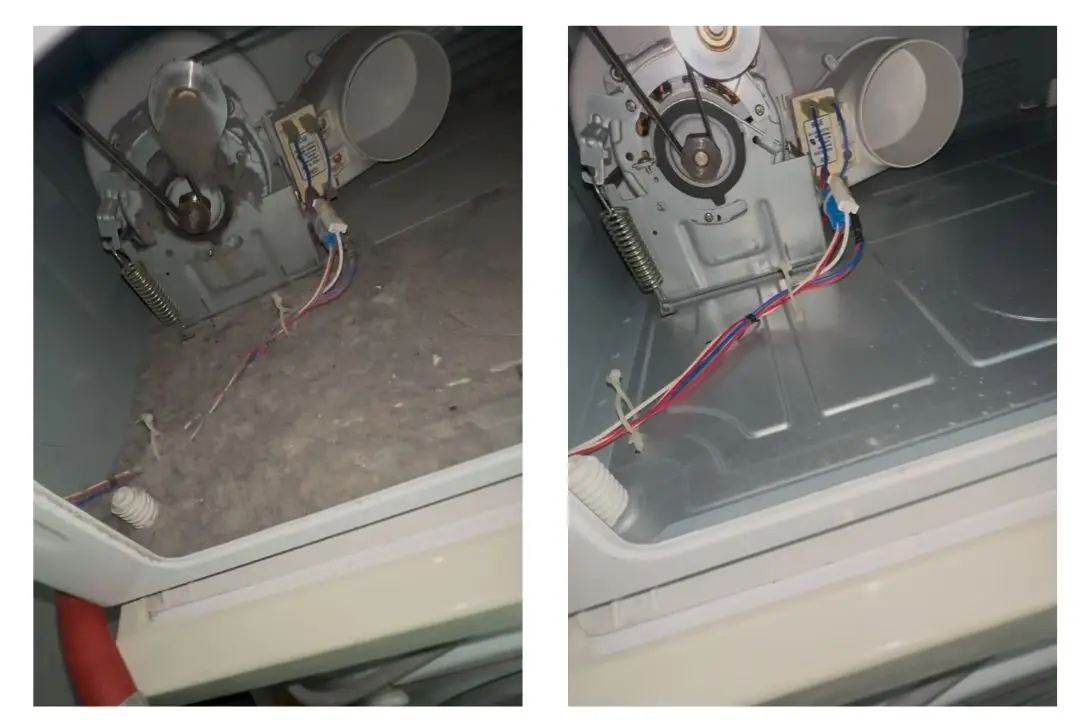
Then the full run, the whole length out to the exterior rather than the first few feet a quick job reaches. Last, the outside hood and damper get cleared, we test the airflow, and you get before and after photographs of your own duct.
A thorough visit runs 45 minutes to an hour and a half depending on the length of the run, how easy it is to reach, and how much is in there. Be careful with anyone advertising a fifteen or twenty minute cleaning. That is enough time for the pipe and not much else.
What do we actually find in local homes?
Lint is the headline. It is not always the problem.
Standing water in the line. One homeowner had a national chain come out, look at the water in the run, and leave saying they could not clean it. We cleared it. That happens more than you would think on runs that dip or terminate low.
Birds and nests. An open or broken hood is an invitation, and a nest will block a run completely. It usually turns up in spring.
Screens that should not be there. Some hoods come with a mesh screen that catches lint immediately. We have talked homeowners through pulling one out over the phone and saved them the visit entirely.
Hoses knocked loose by other trades. New flooring goes in, the dryer gets pushed back, and the hose no longer seats in the floor duct. The dryer then vents into the room. One customer had a check vent light coming on at random and assumed the machine was failing.
Roof and second floor terminations. Upstairs laundry rooms often vent straight up through the roof. Those runs are vertical, long, and almost never inspected.
If your dryer is struggling, call before you buy a new one. We would rather talk you through a five minute fix than sell you a visit you do not need.
What drives the price?
Quotes vary between houses for real reasons, and a company that cannot explain those reasons is worth a second look. Five things move the number:
- Length and bends. More pipe and more elbows mean more time and more places lint hides.
- How easy the run is to reach. Attic, crawlspace, roof or enclosed runs take longer to work safely.
- Condition of the ductwork. A crushed hose, a corroded hood or a seized damper may need parts.
- Gas or electric. Gas machines add checks on the combustion side.
- Nests or debris. Clearing an animal nest is extra work and extra cleanup.
We look first, then quote, then work. You get the price before anything starts, and if we open things up and find something that changes it, we stop and you decide before we carry on.
Can you clean a dryer vent yourself?
Partly, and the easy parts are worth doing between visits.
Clear the lint screen after every load. Every few months pull the screen right out and vacuum down into the housing it sits in, because that cavity fills up even when the screen looks clean. Unplug the dryer, pull it out, disconnect the transition hose, and vacuum what you can reach at both ends. Then go outside and check that the hood flap swings freely.
Stop there if the run is long, climbs through the roof, disappears into a wall or attic, or if you find water. The same goes for anything inside the machine near the heating element or blower. Those need the dryer opened up, and that is exactly where the lint that matters is sitting.
Common questions
How often should I really clean my dryer vent? Once a year, and never past three. Homes with pets, heavy laundry or a long run should stay at the annual end. NADCA points homeowners to a yearly schedule and it matches what we see.
Where do most dryer fires start? Inside the dryer, not in the wall vent. When a blocked run stops lint from leaving, it gathers around the heating element, the blower wheel and the cabinet, and that is where a spark finds something to catch.
Are gas dryers more dangerous than electric? No. NFPA data shows electric dryers are more than 2.5 times as likely to cause a fire, and about 78 percent of dryer fires involve electric machines. Gas dryers carry a separate concern, which is combustion gas backing up if the line is blocked.
Does living near the water change how often I need it done? It changes what we find. Damp salt air makes lint cling to the duct instead of blowing out, and salt corrodes exterior hoods until the flap sticks. Stay on the annual schedule and check the hood.
How long does a professional cleaning take? Usually 45 minutes to an hour and a half, depending on the length of the run, how easy it is to reach, and how much has built up. A fifteen minute service is only covering the pipe.
My dryer stopped working well. Do I need a new one? Often not. A blocked run, a hose knocked loose behind the machine, or a mesh screen in the hood will all make a healthy dryer act like a failing one. Call before you shop.
Get it done before the heating season
Laundry roughly doubles once the clothesline goes away and everyone is back indoors, and dryer fires climb through fall and winter for exactly that reason.
Kealey’s is family run out of Salisbury, serving the North Shore, Seacoast New Hampshire and southern Maine since 1994. Brian started it, his son Keenan runs jobs with him, and Brian’s mechanical engineering background is why the work goes the way it does. Fully insured, and we leave the laundry room cleaner than we found it.
Our dryer vent cleaning page covers what the visit involves. If you want the fire side in more depth we wrote a fuller piece on dryer vent fire prevention, and there is a step-by-step complete guide to dryer vent cleaning as well. If dust in the house is the bigger complaint, that is usually an air duct cleaning question instead.
We cover Salisbury, Amesbury and Newburyport in Massachusetts, Portsmouth, Exeter and Hampton in New Hampshire, and Kittery and York in Maine. The full list is on our service area page.
Request a quote or call (978) 961-4513.