
By Keenan Kealey, Kealey’s Duct and Dryer Cleaning
Your dryer used to finish a load in forty minutes. Now it needs two runs, and the clothes still come out warm and a little damp at the seams. That is the most common call we get, and it is almost never the dryer that is broken.
It is the vent line behind it.
Lint slips past the trap on every cycle. Some of it settles in the duct, and over a few years it packs down into a mat that air cannot move through. Your dryer keeps working exactly the way it was built to. It just cannot push the wet air outside anymore, so it runs longer and hotter trying.
Fall is when most people notice. The clothesline goes away, everyone is back at school or work, and the laundry roughly doubles overnight. The U.S. Fire Administration found that dryer fires climb through fall and winter and peak in January, and that failure to clean the system is the single biggest contributing factor, at 34 percent of cases.
Here is what to watch for, and how to tell a vent problem from an appliance problem before you pay anyone.
Why does my dryer need two cycles to dry one load?
Drying time is the first thing to change, and it changes long before anything smells or feels wrong.
When the duct is clear, hot air carries moisture out of the drum and outside your house. When lint narrows that path, the moist air has nowhere to go, so it circles back through the clothes. The dryer answers by running another heating cycle. You get the same dry laundry eventually, but you paid for twice the electricity to get it.
Vent condition | Typical drying time | Cycles needed |
|---|---|---|
Clear line | 30 to 40 minutes | One |
Partly blocked | 60 to 90 minutes | One to two |
Badly clogged | 90 minutes or more | Two or more |
Most people blame the machine. They assume it is getting old, or that the last load was heavier than usual. Time one normal load against what it used to take. If a regular load of towels has gone from forty minutes to seventy, the vent is the first place to look, not the appliance.
Customers tell us the same thing after a cleaning, almost word for word: clothes dry in one cycle again.
What does a burning smell from the dryer actually mean?
This one deserves an honest answer, because there are two very different causes and only one of them is our job.
A hot, dusty, scorched-fabric smell during a cycle usually means lint is sitting somewhere it is getting cooked. Lint burns easily. In a restricted line, heat that should be leaving the house stays inside the duct and the cabinet instead, and that is what you are smelling. Clearing the run fixes it.
A sharp electrical or melting-plastic smell is different. That points at the machine itself, a failing heating element, a worn belt, or wiring. Cleaning the vent will not solve that, and you want an appliance technician, not us.
If you cannot tell which one you have, stop using the dryer until someone looks at it. That is the one symptom on this page worth acting on the same day.
Why is my dryer hot to the touch?
Heat on the outside of the cabinet means heat is not getting out through the duct.
The top panel, the door, or the wall behind the machine feeling noticeably warm is a sign the system is holding onto energy it was designed to send outdoors. The laundry room itself often feels warmer and more humid than the rest of the house for the same reason. Some people notice a stale, damp smell in that room before they notice anything about the dryer at all.
Running hot also shortens the life of the machine. The heating element and the thermostat are cycling harder than they were built to, which is how a vent problem quietly turns into an appliance bill.
What should the outside vent flap do?
Go outside while a load is running and find the vent hood, usually low on an exterior wall or up through the roof.
The flap should swing open and stay open, with warm air you can feel with your hand. That is a healthy line.
Signs of a problem are easy to read. A flap that stays shut, or barely lifts, means there is not enough air behind it. Lint caked around the opening means air is escaping but debris is stacking up at the exit. A flap propped permanently open with packed lint is the same story further along. Nests are common too, since birds and small animals like a warm sheltered pipe, and that is one we run into more often than people expect on the Seacoast.
If you feel almost no air at the hood while the dryer is clearly running, the blockage is real.
Is it the vent or the dryer?
This is the question worth answering before you spend money, and plenty of companies will not help you answer it.
Point toward the vent when drying times have climbed gradually, the cabinet runs hot, airflow at the outside hood is weak, and lint is visible around the exterior opening. These all describe air that cannot get out.
Point toward the appliance when the drum will not turn, there is no heat at all, the machine is loud or grinding, or the smell is electrical. Those are mechanical failures, and a vent cleaning will not touch them.
Brian has a mechanical engineering background and has been clearing these lines since 1993, so we will tell you on the phone if what you are describing sounds like an appliance problem rather than a vent problem. Sending someone out for work that will not fix anything helps nobody.
Why do local homes clog faster?
Duct shape matters more than duct age.
A short, straight run out an exterior wall mostly clears itself. A run that turns three or four times, climbs through a wall cavity, or crosses a basement ceiling to reach the outside collects lint at every bend. Older homes around Newburyport, Amesbury and Exeter often have exactly that layout, because the laundry got moved long after the house was built and the duct had to take whatever path was available.
Newer construction is not automatically better. Subdivisions frequently put the laundry on a second floor or in an interior closet, which means a long run with several turns to reach daylight.
Coastal air adds to it. Homes in Hampton, Kittery and York deal with humidity that settles into the ductwork and mixes with the lint, and damp lint packs down harder than dry lint does. It also clings to the walls of the duct instead of blowing through.
When should you call someone?
Once a year is the general standard for dryer vent cleaning, and NADCA points homeowners the same direction. Heavy laundry households, long duct runs and homes with pets get there sooner. We covered the timing in more detail in our guide to dryer vent cleaning frequency.
Between those dates, the symptoms above are better guidance than the calendar. Two cycles for one load, a hot cabinet, or a flap that will not open all say the same thing regardless of when the last cleaning happened.
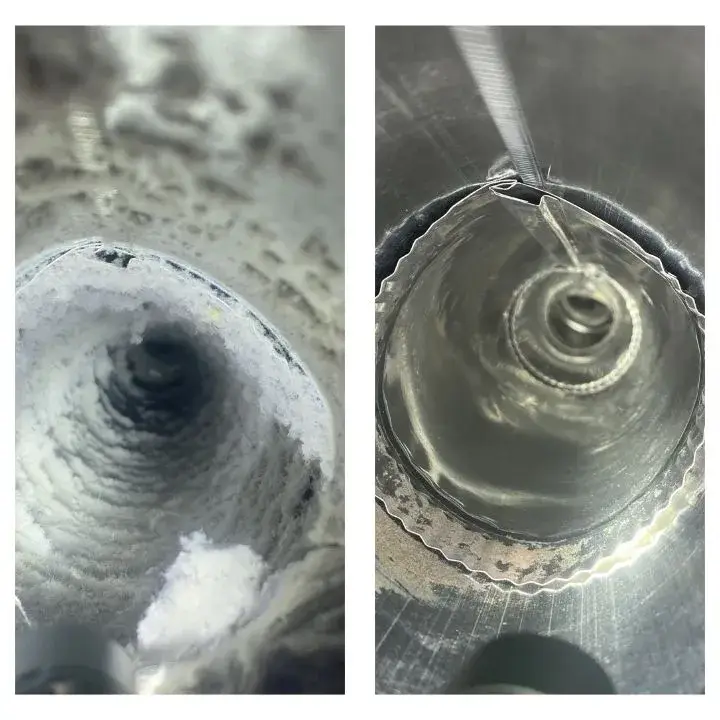
When we come out, you get the price before we start, and you get photos of what came out of your own duct when we finish. Ductwork lives where you cannot see it, so photographs are the only real proof any of this happened. You can see what the visit involves on our dryer vent cleaning page, and if the dust in your house is the bigger complaint, that is usually an air duct cleaning question instead.
For the fire-risk side of this specifically, we wrote a fuller piece on dryer vent fire prevention.
Common questions
What are the main signs of a clogged dryer vent? Clothes needing more than one cycle to dry, a cabinet that feels hot to the touch, a scorched or dusty smell while running, weak airflow at the outside hood, and lint collecting around the exterior flap.
Can I clean the dryer vent myself? You can clear the first few feet behind the machine and the lint trap housing, and that is worth doing. Full runs with bends, second-floor lines, and roof terminations need brushes on a powered line to clear properly, and pushing debris the wrong direction usually makes the packing worse.
Does a clogged vent raise my electric bill? Yes. A dryer running two cycles instead of one is drawing roughly twice the power to do the same job, which is why people often notice the bill before they notice the laundry.
How long does a dryer vent cleaning take? Most take about an hour, depending on how long the run is and how many turns it has. Answers to more of these are on our FAQ page.
Get your vent checked before the heating season
If your dryer is taking two runs to do one load, you are paying for it twice and the line is only packing down further from here.
Kealey’s is family run out of Salisbury, serving the North Shore, Seacoast New Hampshire and southern Maine since 1993. You get an upfront price over the phone, before-and-after photos of your own duct, and no pressure to buy anything you do not need.
Request a quote or call (978) 961-4513.